How to Winterize an Above-Ground Pool in Virginia: 9 Mistakes to Avoid | Luxury Pool & Spa
Best Spa Selection in Central Virginia
Put Some Luxury in Your Backyard!
A PRACTICAL GUIDE FOR VIRGINIA POOL OWNERS
How to Winterize an Above-Ground Pool in Virginia: 9 Mistakes to Avoid
Winterizing an above-ground poolin Virginia means more than putting on a cover and walking away until spring. The pool should be clean, the water properly balanced, and vulnerable equipment protected from freezing. The correct water level and closing procedure depend on the pool, skimmer, plumbing, cover, and manufacturer instructions—so avoid one-size-fits-all advice.
By Luxury Pool & Spa Team
Last updated: October 2, 2026
The short version
- Clean and balance the pool before closing it.
- Don’t assume an above-ground pool should be completely drained.
- Protect pumps, filters, hoses, fittings, and plumbing from freeze damage.
- Follow the pool and equipment manufacturers’ winterization instructions.
- Use the correct winter cover and check it periodically.
- Don’t guess at water chemistry. Test the water before closing.
- If you’re unsure what your pool needs, bring a water sample to Luxury Pool & Spa before you close it.
When Should You Winterize an Above-Ground Pool in Virginia?
There is a momentevery Virginia pool owner knows.
The afternoons can still feel warm enough for summer, but the nights start getting colder. Leaves begin landing in the pool faster than you can skim them out. Then the forecast shows the first genuinely cold stretch of fall.
That’s when the question starts:
Is it time to close the pool?
For owners going through their first winter with an above-ground pool, the next question is usually harder: What exactly am I supposed to do?
Homeowners often ask whether to leave the pool filled, how far to lower the water, what to disconnect, what to do with hoses and equipment, and whether they need an air pillow under the winter cover.
Those are good questions because there isn’t one closing procedure that applies to every above-ground pool.
Here’s how to think through the process without creating a bigger problem for spring.
Don’t close your pool simply because the calendar says October. Water temperature, local weather, the type of pool you own, and your manufacturer’s closing instructions all matter.
Closing too early while the water remains warm can make it harder to keep the water clear until spring. Waiting too long can leave equipment vulnerable if freezing weather arrives before you’ve prepared it.
Virginia makes that decision interesting because fall temperatures can swing dramatically.
Cold nights can be followed by warmer afternoons, so use current conditions and the forecast when planning your closing date.
There is also meaningful variation within Central Virginia.
National Weather Service climate data shows that the median first 32°F freeze varies considerably across Virginia locations. Historical 1991–2020 data, for example, lists median first-freeze dates ranging from late October in some areas to early November around Richmond International Airport.
That doesn’t mean you should wait for the first freeze.
It means there isn’t one perfect closing date for every Central Virginia backyard.
Watch the weather, water temperature, and your equipment requirements. Give yourself enough time to close the pool properly before sustained freezing weather becomes a concern.
Should You Completely Drain an Above-Ground Pool for Winter?
Do not assume that a permanent above-ground pool should be completely drained for winter. Many above-ground pools are designed to remain standing with water in them, but the correct procedure depends on the specific pool.
This is one of the most important distinctions in the entire closing process.
A permanent hard-sided above-ground pool is not the same thing as every portable or seasonal pool sold for backyard use. Some seasonal pools may have manufacturer instructions that call for disassembly and indoor storage. Permanent above-ground pools can have very different requirements.
Before draining anything, check:
- Your pool owner’s manual
- Liner requirements
- Skimmer configuration
- Return fittings
- Plumbing arrangement
- Winter cover requirements
- Manufacturer winterization instructions
Why be so careful?
The water inside a permanent above-ground pool can be part of what supports the liner and pool structure. Removing more water than the manufacturer recommends may create problems of its own.
This is an area where generic internet instructions can get homeowners into trouble.
Know which type of pool you own before following someone else’s closing procedure.
How Far Should You Lower the Water in an Above-Ground Pool?
There is no single water level that is correct for every above-ground pool. The right level depends on your skimmer, return fittings, winter plugs or skimmer protection, cover system, and manufacturer’s instructions.
You’ll see plenty of universal measurements online.
Treat them cautiously.
One pool may need the water lowered below a particular fitting. Another setup may use a winter skimmer plate or plugs that allow the owner to maintain a different water level.
A removable skimmer connected by hose can require a different winterization approach from a permanently plumbed skimmer.
That’s why the better question isn’t:
“How many inches should everybody drain?”
It’s:
“What water level does my specific pool and winterization setup require?”
Check the manufacturer’s closing instructions before changing the water level.
If you’re unsure, identify your pool model, skimmer, return configuration, filter, and cover before proceeding.
Should You Balance Pool Water Before Closing It?
Yes. The pool should go into winter clean and with its water chemistry properly prepared according to the requirements of your pool and water-care system. Closing dirty or poorly balanced water can create a much more difficult spring opening.
Think about what happens after the cover goes on.
You aren’t looking at that water every afternoon anymore. Circulation may be shut down. Leaves, organic contaminants, and existing water-balance problems don’t magically disappear because swimming season is over.
Before closing, start with a clean pool and reliable water test.
Depending on your water-care system, you’ll want to evaluate the appropriate chemistry before adding winter products.
The important part is testing instead of guessing.
Adding extra chemicals because “it’s closing day” isn’t a water-care strategy.
Not sure if your pool water is ready for winter?
Bring a water sample to Luxury Pool & Spa before closing.
Luxury Pool & Spa operates Central Virginia showrooms in Charlottesville, Fredericksburg, Richmond/Midlothian, and Henrico. Its local showroom pages list pools, pool supplies, and water care among the products and services available.
Getting the water right before the cover goes on can save a lot of frustration when that cover comes back off.
What Should You Do With the Pump, Filter, and Hoses?
Equipment that can hold water needs appropriate freeze protection. Follow the winterization instructions for your specific pump, filter, heater, chlorinator, hoses, and other connected equipment.
Water expands when it freezes.
That’s the simple reason this part matters so much.
Water left trapped in vulnerable equipment or plumbing can freeze and create damage. Exactly how equipment should be drained, disconnected, plugged, stored, or otherwise winterized varies by system.
Before closing, identify every part of the circulation system:
- Pump
- Filter
- Flexible or rigid plumbing
- Skimmer
- Return fittings
- Chlorinator or sanitizer equipment
- Heater, if equipped
- Robotic or automatic cleaner
- Additional water features or accessories
Then follow the manufacturer’s winterization procedure for each component.
Don’t assume that shutting off the pump means the equipment is winterized.
And don’t rely on memory from a different pool. A sand filter, cartridge filter, removable hose system, and permanently plumbed setup may require different steps.
Should You Leave Your Pool Cleaner in the Pool All Winter?
Unless the manufacturer specifically says the cleaner is designed for winter storage in the pool, remove it and follow its cleaning and storage instructions.
This is easy to overlook.
The last swim is over. The cleaner is sitting at the bottom of the pool. The cover is ready.
It can be tempting to leave everything where it is.
Instead, treat pool accessories as part of the closing checklist.
That may include:
- Robotic cleaners
- Automatic cleaners
- Ladders
- Steps
- Thermometers
- Floating dispensers
- Toys
- Cleaning tools
- Removable hoses
- Other seasonal accessories
Clean and dry items as appropriate before storage.
Luxury Pool & Spa currently carries Vogue above-ground pools along with pool-maintenance products and robotic pool cleaners, so homeowners replacing or updating pool equipment can compare compatible options through the company’s Central Virginia locations.
Does an Above-Ground Pool Need a Winter Cover?
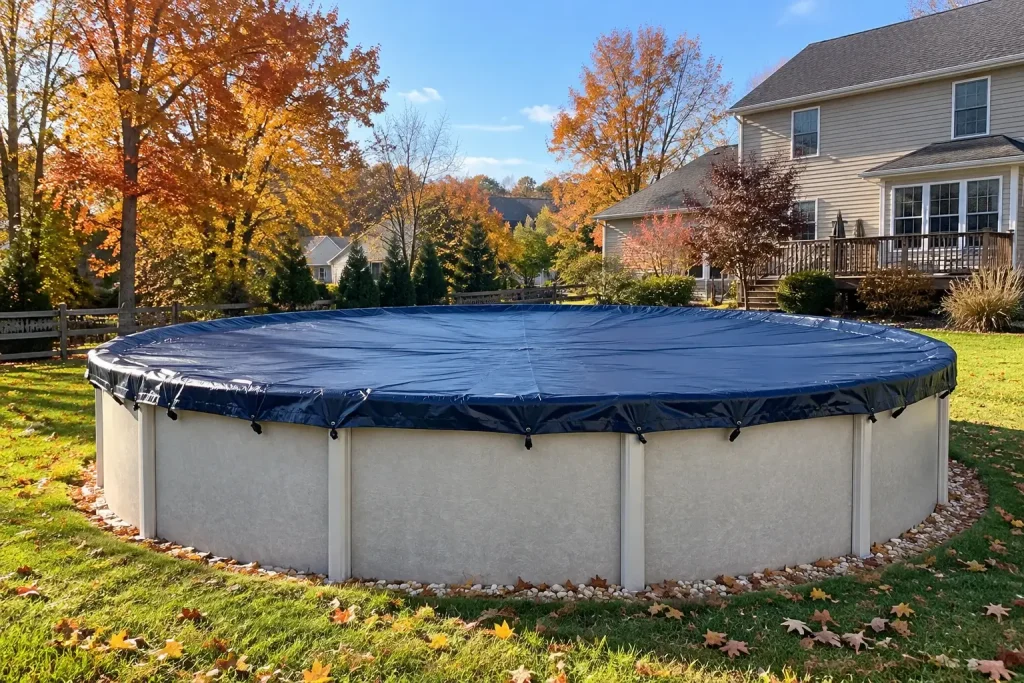
A properly selected and installed winter cover can help keep leaves and debris out of the pool, but the cover must be appropriate for your specific pool and installed according to its instructions.
A cover isn’t just something to throw over the top once you’re finished.
Fit matters.
Installation matters.
What happens to the cover after a month of rain, leaves, wind, or snow matters too.
Before buying or installing a cover, confirm:
- Pool shape and dimensions
- Cover type
- Installation method
- Required overlap
- Cable, winch, straps, or other securing method
- Whether the system uses an air pillow
- How accumulated water or debris should be handled
- Manufacturer limits for snow or other loads
A badly fitted or neglected cover can create its own problems.
Water allowed to accumulate on a sagging cover can carry debris into the pool when the cover is removed. Follow the cover instructions for managing accumulated water.
That’s a useful reminder:
Closing day isn’t the last day you should look at your pool until spring.
Do You Need an Air Pillow Under an Above-Ground Pool Cover?
Some above-ground winter-cover systems use air pillows, but you should not assume every pool or cover requires one. Follow the instructions for your specific pool and winter cover.
Air pillows are commonly discussed as part of above-ground pool winterization, which is why first-time owners frequently ask about them.
But the fact that another homeowner uses one doesn’t automatically mean your pool needs the same setup.
If your cover instructions call for an air pillow, follow the manufacturer’s directions for:
- Pillow size
- Inflation
- Position
- Securing it
- Cover installation
Avoid improvising based solely on a photograph or social-media post.
The goal is to install the winter-cover system the way it was designed to be used.
Should You Add Winterizing Chemicals to an Above-Ground Pool?
Use winterizing chemicals only as appropriate for your pool’s water-care system and according to product directions. Test the water first rather than automatically adding a generic closing kit.
This is another place where homeowners can accidentally make pool care harder than it needs to be.
A winter kit isn’t a substitute for understanding the water.
The correct treatment can depend on factors such as:
- Current sanitizer level
- pH and overall water balance
- Water-care system
- Pool volume
- Existing algae or cloudiness
- Product formulation
- Water temperature
- Manufacturer directions
If the pool is already cloudy or green, don’t assume that covering it will make the problem disappear.
Address the water before closing.
A practical example
Imagine two neighbors in Henrico closing similar-sized above-ground pools on the same weekend.
One pool has clear, properly balanced water.
The other has cloudy water after weeks of falling leaves and inconsistent maintenance.
Using the exact same closing chemicals in both pools without testing ignores the fact that they are starting from different conditions.
Test first. Treat the water you actually have.
That’s a much better rule than simply following a shopping list.
What Should You Check After the Pool Is Closed?
Check the pool periodically throughout winter. Look at the cover, water level, accumulated debris, surrounding drainage, and anything that appears loose, damaged, or out of position.
Virginia winter weather isn’t always predictable.
You can get rain, wind, freezing nights, warmer stretches, and occasionally significant snow or ice during the same season.
Make a habit of looking at the pool after major weather.
Check for:
- Excess water on the cover
- Heavy debris accumulation
- Loose cover hardware
- Cover movement
- Unexpected changes in pool water level
- Damage around the pool wall
- Drainage problems around the pool
- Visible equipment problems
How accumulated water or snow should be removed depends on the cover, so follow the cover manufacturer’s instructions rather than attacking it with a shovel or improvised tool.
Sharp objects and pool covers are a poor combination.
What Are the Biggest Above-Ground Pool Winterization Mistakes?
Most expensive closing mistakes come from assumptions: draining without checking instructions, closing dirty water, leaving water trapped in vulnerable equipment, or ignoring the pool until spring.
Here are nine mistakes worth avoiding.
| Mistake | Better Approach |
|---|---|
| 1. Completely draining the pool without checking | Follow the specific pool manufacturer’s winterization instructions. |
| 2. Guessing at the winter water level | Base the level on the pool, skimmer, return fittings, winterization system, and cover instructions. |
| 3. Closing cloudy or dirty water | Clean and test the pool before closing. |
| 4. Adding chemicals without testing | Treat the actual water conditions and follow product directions. |
| 5. Forgetting water inside vulnerable equipment | Follow each component manufacturer’s freeze-protection procedure. |
| 6. Leaving removable accessories in the pool | Clean and store seasonal accessories as directed. |
| 7. Improvising the cover installation | Use a properly sized cover and follow its installation instructions. |
| 8. Closing too late | Plan ahead of sustained freezing conditions. |
| 9. Ignoring the pool all winter | Inspect it periodically and after significant weather. |
Print that table if you need to.
A five-minute check before closing can be a lot cheaper than discovering damage in April.
What Should First-Time Pool Owners Do Before Closing?
Start by identifying exactly what you own. Your pool model, skimmer, filter, plumbing, sanitizer system, and cover determine the closing procedure.
If this is your first winter with an above-ground pool, don’t be embarrassed if you’re not sure where to start.
Write down:
- Pool manufacturer and model
- Pool dimensions
- Liner type
- Skimmer type
- Return fitting
- Pump model
- Filter type and model
- Sanitizer or water-care system
- Heater model, if applicable
- Cleaner model
- Winter cover type
Find the owner’s manuals.
Then make your closing checklist.
That is far safer than watching one video from a person whose pool happens to look roughly like yours.
Follow your pool and equipment instructions
Pool designs and equipment vary. Winterization procedures should follow the instructions provided by the manufacturers of the pool, liner, pump, filter, plumbing components, sanitizer system, and winter cover. When uncertain, consult the applicable manufacturer’s documentation or a qualified pool professional.
People Also Ask & Frequently Asked Questions
Can you leave an above-ground pool up all winter in Virginia?
Many permanent above-ground pools are designed to remain standing through winter, but owners should follow the specific pool manufacturer’s instructions. Seasonal or portable pools may have different requirements. The pool, liner, water level, plumbing, equipment, and cover all need to be prepared appropriately for freezing conditions.
Do you have to drain an above-ground pool below the skimmer?
Not in every setup. The required winter water level depends on the skimmer design, return fittings, winter plugs or plates, cover system, and pool manufacturer’s instructions. Avoid following a universal measurement without checking the requirements for your specific pool.
What temperature should you close a pool in Virginia?
There isn’t one closing temperature that applies to every pool. Many owners wait until water temperatures have cooled because colder water generally reduces biological activity, but you also need enough time to winterize equipment before freezing conditions arrive. Follow your pool and chemical manufacturers’ recommendations.
Should you shock a pool before closing it?
The correct closing treatment depends on your water chemistry and sanitizer system. Test the water first and follow the directions for the products and pool system you use. Don’t automatically add a large chemical dose simply because you’re closing the pool.
Do you need to check a covered pool during winter?
Yes. Periodically inspect the cover, pool water level, debris accumulation, surrounding drainage, and visible pool components. Check again after major rain, wind, snow, or ice events. Follow the cover manufacturer’s directions for safely managing accumulated water, debris, or snow.
Can you close a cloudy pool for winter?
It’s better to identify and correct the cause before closing. Cloudiness can be associated with water-balance, sanitation, filtration, circulation, or contamination issues. Test the water, clean the pool, and resolve known problems before installing the winter cover.
Frequently Asked Questions
What happens if I completely drain my above-ground pool?
The consequences depend on the type of pool. Permanent above-ground pools may rely on water to help support the liner and structure, so complete draining may cause problems. Some seasonal pools are designed to be drained and stored. Always check the manufacturer’s instructions before removing large amounts of water.
Should I remove my above-ground pool ladder for winter?
Removable ladders, steps, and other seasonal accessories are commonly removed, cleaned, and stored during winter, but follow the manufacturer’s instructions for your equipment. Removing appropriate accessories also makes it easier to install and secure many types of winter covers correctly.
Can I leave my pool pump outside during winter?
That depends on the pump, installation, and manufacturer’s winterization instructions. The critical issue is preventing freeze damage from trapped water. Follow the pump manufacturer’s procedure for draining, winterizing, disconnecting, or storing the equipment rather than assuming every above-ground pool pump should be handled the same way.
What should I bring to Luxury Pool & Spa before closing my pool?
Bring a pool-water sample if you need help evaluating water chemistry. It is also useful to know your pool size, sanitizer system, filter type, and the products you’ve recently added. If you’re shopping for a replacement part or accessory, having the manufacturer and model information can help identify what you need.
Sources: National Weather Service: first-freeze climate data, 1991–2020; Luxury Pool & Spa pools; water care; showrooms.
Where Can You Get Pool Water Tested in Central Virginia?
Luxury Pool & Spa serves pool and spa owners through showrooms in Charlottesville, Fredericksburg, Richmond/Midlothian, and Henrico. The company sells above-ground pools, pool supplies, and water-care products.
If you’re preparing to close your pool and aren’t sure about the water, bring a sample in before you cover it.
That gives you a chance to deal with a water problem now instead of meeting it again when you open the pool next spring.
Visit your nearest Luxury Pool & Spa location in Charlottesville, Fredericksburg, Richmond/Midlothian, or Henrico.
Bring your pool information—and if water chemistry is the question, bring a water sample.
A little preparation in the fall can make opening day much easier.
Before you close the pool
- Is the water clean?
- Have I tested it?
- Do I know the correct winter water level for this pool?
- Have I followed the manufacturer’s closing instructions?
- Is every vulnerable piece of equipment protected from freezing?
- Have I removed and stored the appropriate accessories?
- Is the winter cover correct for my pool?
- Do I know how to maintain the cover during winter?
If any answer is “I’m not sure,” figure it out before closing.
50% Sale on in-stock limited stock Maxx sauna & cold plunge models! |

















CHARLOTTESVILLE
257 Connor Dr A
Charlottesville, VA 22911
Sun: Closed
PHONE: (434) 202-2331
FREDERICKSBURG
9755 Patriot Hwy
Fredericksburg, VA 22407
Sun: Closed
RICHMOND
2045 Walmart Way
Midlothian, VA 23113
Sun: Closed
HENRICO
3426 Pump Rd.
Henrico, VA 23233