Cloudy Pool Water Causes
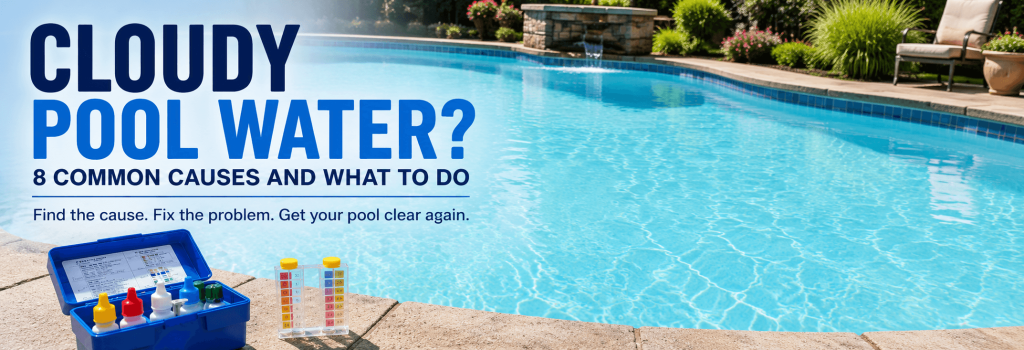

Why Is My Pool Water Cloudy? 8 Common Causes and What to Do
Pool water can become cloudy when sanitizer levels fall, pH moves outside the recommended range, filtration becomes inadequate, circulation slows, or contaminants overwhelm the system. Heavy swimming, thunderstorms, pollen, dirt, sunscreen, algae, and equipment problems can all contribute.
Sometimes several things happen at once.
A Saturday pool party adds sunscreen, sweat, dirt, and a larger bather load. Then a summer thunderstorm rolls through Central Virginia that evening. By Sunday morning, a pool that looked perfectly clear on Friday can be struggling.
Here are the eight places we would investigate first.
1. Is your sanitizer level too low?
Low sanitizer can allow contaminants and microorganisms to build up faster than the pool can control them. That can contribute to dull, hazy, or cloudy water and may eventually lead to algae growth.
The CDC recommends testing residential pool water and notes a typical chlorine range of 1–4 ppm and bromine range of 3–8 ppm, while also advising owners to follow the manufacturer’s instructions for their specific products.
Don’t judge sanitizer by smell.
A pool with a strong “chlorine” smell is not necessarily well sanitized. Chlorine can combine with sweat, dirt, and other contaminants to form chloramines, which can contribute to the familiar pool odor and irritation.
What to do: Test before treating. If the reading is outside the range recommended for your water-care system, correct it according to the product instructions or have the water professionally analyzed.
2. Is the pH out of balance?
The CDC recommends a pool pH of 7.0–7.8. When pH moves too high or too low, sanitizer can become less effective, swimmers may experience irritation, and pool equipment can also be affected.
This matters because a homeowner can keep adding sanitizer while missing the underlying balance issue.
Think of it this way: adding more product does not fix the problem if the water conditions are preventing that product from working properly.
What to do: Test pH alongside sanitizer rather than checking one value in isolation.
3. Is your filter dirty or struggling?
Your filter has one basic job: remove material from the water.
When the filter is dirty, undersized, damaged, incorrectly operated, or overdue for service, fine suspended particles can remain in the pool instead of being captured.
The result can look like a chemistry problem even when filtration is part of the issue.
Ask:
- When was the filter last cleaned?
- Has filter pressure changed?
- Is the pump running normally?
- Is water returning strongly to the pool?
- Is the filter media due for service or replacement?
- Has circulation changed since the pool was clear?
Luxury Pool & Spa sells pool-care products and pool maintenance equipment, including robotic pool-cleaning systems.
What to do: Check the manufacturer’s instructions for your filter type and clean, backwash, or service it as required.
4. Has your pool had unusually heavy use?
More swimmers mean more material entering the water.
Sunscreen, body oils, sweat, cosmetics, dirt, grass, and other contaminants all increase the work expected from the sanitizer and filtration system.
A pool that stays perfectly clear when two people use it may react differently after ten people spend an afternoon in it.
This is one reason water should be checked more frequently during periods of heavy use. CDC guidance recommends regular home pool and hot-tub testing and emphasizes maintaining appropriate sanitizer and pH levels.
What to do: After unusually heavy use, inspect the water, check sanitizer and pH, and make sure circulation and filtration are operating as expected.
5. Did a Central Virginia storm just pass through?
August weather can change pool conditions quickly.
Rain can introduce debris and affect water chemistry. Wind carries leaves, soil, pollen, and organic matter into the pool. A hard storm can also change the water level and increase the amount of material the filtration system must remove.
The pool may look fine before dinner and completely different the next morning.
What to do: Remove visible debris, empty baskets, check circulation, test the water, and address the actual readings instead of automatically adding a large dose of chemicals.
6. Could algae be starting?
Algae does not always begin as a dramatic green swamp.
Early growth may appear as dullness, slight cloudiness, slippery surfaces, discoloration, or areas that seem to return after brushing.
If water clarity continues declining even after correcting basic balance issues, algae should be considered as one possible cause.
What to do: Check sanitizer, inspect walls, steps, ladders, corners, and areas with weaker circulation. Follow the treatment program appropriate for your pool and water-care system.
If you’re not sure whether you’re looking at algae, mineral cloudiness, or suspended debris, that’s exactly when a professional water test becomes useful.
7. Are fine particles staying suspended in the water?
Some particles are so small that they remain suspended instead of quickly settling or being captured.
Luxury Pool & Spa’s own hot-tub water-care guidance describes cloudy water as a hazy appearance created by suspended particles and notes that poor water balance, insufficient sanitizer, inadequate oxidation, filtration issues, and circulation can contribute. Although pool and hot-tub systems are not identical, the underlying lesson is useful: cloudiness can have several overlapping causes.
This is why pouring in random products until the water looks better is a poor long-term strategy.
You may temporarily improve the appearance without correcting the reason it happened.
8. Are you treating the wrong problem?
This catches a lot of pool owners.
Cloudy water can tempt you into treating what you think is wrong:
“It’s probably chlorine.”
“It’s probably algae.”
“It’s probably the filter.”
Maybe.
But if you haven’t tested the water, you’re still guessing.
Adding unnecessary chemicals can make water balance more difficult and cost more than simply diagnosing the problem correctly from the beginning.
What should you check first when your pool turns cloudy?
Use this quick checklist before adding anything:
- Check whether you can clearly see the pool bottom.
- Test sanitizer.
- Test pH.
- Check the pump and water circulation.
- Inspect and clean baskets.
- Check the filter pressure and condition.
- Look for visible algae or slippery surfaces.
- Think about recent heavy swimming.
- Consider recent storms, pollen, or yard debris.
- Review anything recently added to the water.
- If the cause isn’t clear, have the water professionally tested.
Can you swim in cloudy pool water?
If the water is so cloudy that you cannot clearly see the bottom or a person beneath the water, stay out until water clarity and safety have been restored.
Cloudiness can also indicate that sanitation, circulation, or filtration is not working as intended.
The safest approach is to identify and correct the cause before swimming.
Should you just shock a cloudy pool?
Not automatically.
Oxidation or shock treatment may be appropriate for some water conditions, but it is not the correct response to every cloudy pool.
If the underlying problem is filtration, circulation, incorrect pH, mineral imbalance, or another issue, automatically adding more sanitizer may not solve it.
Test first. Treat second.
That’s the habit that makes pool ownership much easier.
When should you bring your pool water in for professional testing?
Bring in a sample when the water remains cloudy despite routine maintenance, readings don’t make sense, algae repeatedly returns, you’re unsure which product to use, or you’re tired of correcting one number only to have another move.
Luxury Pool & Spa offers full-service water testing and instruction and carries pool-water-care brands and systems including Baquacil, Poolife, Natural Chemistry and other products listed in its current water-care range.
Before bringing a sample
For the most useful test, use a clean container and take the sample from the pool rather than from a hose or bottle of source water.
Then bring it to your nearest Luxury Pool & Spa location.
Stop Guessing at Your Pool Water
If your pool is cloudy, green, foamy, difficult to balance, or simply doesn’t look right, bring us a water sample.
Luxury Pool & Spa serves pool and spa owners through locations in Midlothian/Richmond, Henrico, Charlottesville, and Fredericksburg and provides professional water testing and instruction.
People Also Ask
Why is my pool cloudy even when the chlorine is good?
Cloudiness can have causes beyond sanitizer, including filtration, circulation, pH, debris, heavy bather load, early algae growth, and fine suspended particles. A “good” chlorine reading is only one part of the water picture. Test the full water balance and inspect the circulation and filtration system.
How quickly can cloudy pool water clear?
There is no single clearing time because the cause matters. A minor balance or filtration issue may improve relatively quickly once corrected, while algae, equipment problems, or severely unbalanced water can take longer. Identify the cause first and continue filtration and treatment according to the pool-care system’s instructions.
Can too much pool chemical make water cloudy?
Yes, inappropriate treatment can contribute to water-balance problems or create conditions that affect clarity. This is why adding products without testing is risky. Measure first, understand the readings, and follow the instructions for your pool-care system instead of repeatedly adding chemicals based only on appearance.
Does running the pool pump help cloudy water?
Proper circulation and filtration are important for removing suspended material, so adequate pump and filter operation can be part of clearing cloudy water. However, running the pump cannot correct every chemistry or sanitation problem by itself. Check both the mechanical system and the water chemistry.
FAQs
Should I use test strips or professional pool-water testing?
Home test strips are useful for routine monitoring when used according to their instructions. Professional water testing can provide additional information when water remains difficult to balance or you’re unsure what the readings mean. The most effective approach is consistent home testing with professional help when troubleshooting becomes complicated.
Why does my pool get cloudy after a party?
A large number of swimmers adds sunscreen, sweat, dirt, oils, and other contaminants to the water. That increases demand on sanitizer and filtration. Check water balance and circulation after unusually heavy use rather than waiting for water clarity to deteriorate.
Why does my pool look cloudy after rain?
Rain and wind can introduce debris and organic material, alter water conditions, increase the water level, and place additional demand on filtration and sanitizer. After significant weather, remove debris, inspect circulation and filtration, and test the water before deciding what treatment is necessary.
Where can I get pool water tested in Central Virginia?
Luxury Pool & Spa offers full-service water testing and instruction through its Central Virginia locations in Richmond/Midlothian, Henrico, Charlottesville, and Fredericksburg. Customers can bring in a water sample for help understanding the condition of their pool or spa water.