
Hot Tubs in Central Virginia: 9 Buying Tips
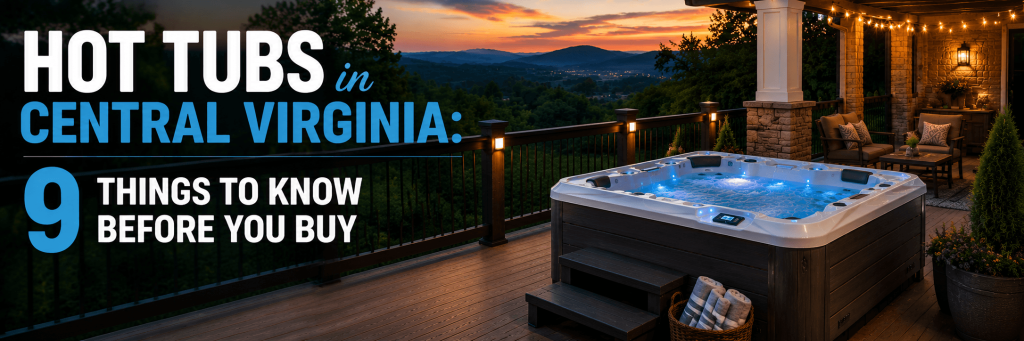

The best hot tub is not necessarily the one with the most seats, the highest jet count, or the biggest discount. For Central Virginia homeowners, the right choice comes down to comfort, hydrotherapy, insulation, installation requirements, water care, warranty protection, and dependable local service. Whenever possible, test the spa before deciding.
IMPORTANT
- Buy for the people who will use the spa every week—not the biggest party you might host.
- Sit in or wet-test different models before buying.
- Compare jet placement and massage quality, not simply jet count.
- Ask about insulation, electrical requirements, water care, warranty and service.
- Compare the total ownership experience, not only the sticker price.
By August, something begins to change in Central Virginia.
The pool still feels great in the afternoon, but nights start arriving a little earlier. Before long, that same backyard that was built around staying cool becomes a place where warm water sounds much better.
That’s when hot-tub shopping tends to get serious.
And there’s a mistake worth avoiding from the beginning: shopping from a specification sheet instead of shopping for the way you’ll actually use the spa.
Luxury Pool & Spa has served Central Virginia since 1988 and currently operates showrooms serving Richmond/Midlothian, Henrico, Charlottesville, and Fredericksburg. The company says its employees have more than 100 years of combined pool-and-spa industry experience and offers professional spa service, water testing, and instruction.
Here are nine questions worth answering before you buy.
1. What size hot tub do you actually need?
Choose a spa around your normal number of users, then consider whether an extra seat or two makes sense for guests.
A couple does not automatically need a seven-person hot tub.
Likewise, a family of five probably shouldn’t squeeze into a model designed primarily for two adults simply because it costs less.
Luxury Pool & Spa currently organizes its selection into 1–3 seat, 4–5 seat, and 6–8+ seat categories, making capacity a useful first filter.
But capacity numbers don’t tell the whole story.
Ask:
- How many people will use it most evenings?
- Does anyone want a full-body lounge?
- Are users different heights?
- Does anyone need easier entry and exit?
- Do you want conversation or individual massage stations?
- Will children occasionally use the spa with adult supervision?
- How much patio or deck space is available?
A six-seat spa with the wrong seating layout can feel smaller than a well-designed five-seater.
2. Should you wet-test a hot tub before buying?
If the dealer offers it, yes.
A wet test lets you experience things that simply cannot be judged from photographs: buoyancy, seat depth, jet placement, noise, water movement and how comfortably your body stays in position.
Luxury Pool & Spa specifically offers a free test soak, allowing shoppers to test different hot-tub models before purchasing. The company’s buying guidance says wet tests help customers evaluate jets, water depth and how the seats fit their bodies.
That matters.
A lounge chair can look perfect when it’s dry. Add water, and a shorter user may find themselves floating away from the massage position.
During a test soak, check:
- Can you comfortably keep your feet down?
- Does the lounge hold you in position?
- Do jets actually hit your shoulders or lower back?
- Is the seat too deep?
- Can you move between seats comfortably?
- How noisy is the spa with multiple pumps operating?
- Can you reach the controls without getting up?
CTA: Don’t Just Look at a Hot Tub—Try One
Schedule a free test soak before making your final decision.
3. Are more hot-tub jets always better?
No.
The number of jets tells you very little by itself about the quality of the massage.
Jet position, pump performance, adjustability, seat ergonomics and plumbing design matter. Hot Spring’s published guidance similarly notes that simply adding many jets without adequate pump performance can result in weak massage action and that larger pumps can also affect energy consumption.
Instead of asking:
“How many jets does this have?”
Ask:
“What does this seat do for the areas where I actually want massage?”
If your shoulders are the problem, forty powerful foot and calf jets won’t solve it.
Compare:
- Neck and shoulder jets
- Upper-back massage
- Lower-back massage
- Leg and calf jets
- Foot jets
- Adjustable pressure
- Different massage patterns
- Ability to turn individual stations on and off
Luxury Pool & Spa currently carries hot-tub lines that include Jacuzzi, Sundance, Vita Spa, American Whirlpool, AquaSolus, Innova Spa and Pür Spas, providing shoppers multiple seating and hydrotherapy configurations to compare.
4. How much does a hot tub cost to run in Virginia?
There is no honest universal monthly number.
Operating cost depends on:
- Spa size
- Water volume
- Insulation
- Cover quality
- Outdoor temperature
- Desired water temperature
- Usage
- Pump operation
- Local electricity rates
That last part matters in Central Virginia because the same spa will not face identical conditions in August and January.
Insulation is particularly important because retaining heat reduces the amount of work required to bring the water back to temperature. Manufacturer guidance from Hot Spring likewise identifies insulation as a significant factor in long-term operating costs.
When comparing spas, ask the salesperson to explain how the spa retains heat, not simply to tell you it is “energy efficient.”
Also inspect the cover. An aging, waterlogged, damaged, or poorly fitting cover can undermine an otherwise efficient spa.
5. Do you need 120V or 240V electrical service?
It depends on the hot tub.
Some plug-and-play spas are designed for a standard electrical connection, while many larger or higher-performance spas require dedicated 220–240V service. Hot Spring’s current buyer guidance notes that many models require 220V or 230V electrical installation completed by a licensed electrician.
Do not wait until delivery morning to think about electricity.
Before choosing the final location, confirm:
- Exact electrical requirements
- Breaker requirements
- Disconnect placement
- Distance from the electrical panel
- Local code requirements
- Who will complete the electrical work
Electrical installation should be handled by qualified professionals and follow the spa manufacturer’s requirements and applicable code.
6. Where should the hot tub go?
The best location balances convenience, privacy, structural support, drainage, delivery access and future service access.
It’s easy to focus entirely on the view.
Then January arrives.
A hot tub seventy feet from the back door, across a dark lawn, may not get used nearly as often as one with a short, safe path from the house.
Think about:
- Foundation
- Drainage
- Electrical access
- Privacy
- Wind exposure
- Lighting
- Steps
- Cover lifter clearance
- Equipment-panel access
- Gates and delivery route
- Deck structure
- Overhead obstacles
Most importantly, do not trap the mechanical equipment behind permanent landscaping or construction.
Somebody will need access eventually.
7. How difficult is hot-tub water care?
It should become a routine—not a guessing game.
Home spa owners need to monitor sanitizer and pH, clean filters, remove debris, inspect the water and periodically drain and refill the spa according to manufacturer recommendations and actual usage.
The CDC recommends a hot-tub pH of 7.0–7.8 and at least 3 ppm chlorine for residential hot-tub water; it also provides bromine guidance and advises following product directions.
Luxury Pool & Spa offers full-service water testing and instruction and carries multiple spa-water-care systems and brands.
For new owners, that local help has real value.
The first time water turns cloudy or foamy, you want somewhere to take a sample—not another hour scrolling through conflicting advice.
8. How important is the dealer after the sale?
Very.
The hot tub is the product.
Ownership is the relationship.
Eventually you may need:
- Filters
- Water-care supplies
- A replacement cover
- Troubleshooting
- Warranty assistance
- Pumps or controls serviced
- Help with water chemistry
- Replacement parts
Luxury Pool & Spa says it maintains a professionally trained spa-service staff along with full-service water testing and instruction.
Before buying from any dealer, ask:
- Who handles warranty calls?
- Who performs service?
- Is the technician local?
- What areas does the service department cover?
- What happens after the warranty expires?
- How quickly can common replacement parts be sourced?
- Can I bring water in for testing?
- Who do I call when I don’t understand the chemistry?
Those questions may be more important five years from now than whether the spa had four extra lights.
9. Should price be the deciding factor?
Price matters.
But compare total value, not simply the number written on a showroom tag.
Two hot tubs can look similar while differing considerably in construction, insulation, pumps, hydrotherapy, controls, cover quality, warranty coverage, water-care features and dealer support.
The cheaper tub can still be the better purchase.
Or it can become the more expensive one.
Ask for clarity about:
Question | Why it matters |
What’s included in the price? | Prevents surprise costs |
What electrical work is needed? | Affects installation budget |
Is delivery included? | Changes the real purchase price |
What cover is included? | Affects convenience and heat retention |
How long is the warranty? | Helps compare protection |
Who performs warranty service? | Determines what happens when there’s a problem |
What water-care system is included? | Affects maintenance |
Can I wet-test the spa? | Helps prevent choosing the wrong seating |
Is financing available? | Helps compare total budget options |
What’s the best way to compare hot tubs in Central Virginia?
Do three things:
Sit in them.
Wet-test your finalists.
Ask about service before asking for the final price.
Luxury Pool & Spa currently has locations serving Richmond/Midlothian, Henrico, Charlottesville and Fredericksburg and offers hot tubs across several brands and seating categories.
You don’t need to walk into the showroom knowing exactly which model you want.
You should walk in knowing how you want to use it.
Hot-Tub Buying Checklist
Before signing anything, make sure you know:
- Normal number of users
- Preferred seating layout
- Desired massage areas
- Spa dimensions
- Foundation requirements
- Electrical requirements
- Delivery path
- Cover requirements
- Water-care system
- Warranty length
- Who performs service
- What’s included in the quoted price
- Financing terms, if applicable
Come Feel the Difference
Photos can show you the shell.
Specifications can tell you how many jets it has.
Neither can tell you how the spa feels.
Schedule a free test soak at Luxury Pool & Spa or visit a Central Virginia showroom to compare models in person.
People Also Ask
What is the best time of year to buy a hot tub in Virginia?
There isn’t one universal best month. The better question is when you want the spa installed and ready to use. Shopping before colder weather gives homeowners time to compare models, plan the foundation and electrical work, organize delivery and learn water care before winter soaking becomes especially appealing.
How many people can comfortably fit in a hot tub?
Published capacity is a useful starting point, but comfort depends on seating design, user height, lounges and footwell space. A model advertised for six may feel perfect for one family and crowded for another. Sitting in or wet-testing the actual spa is the best way to judge usable capacity.
Is it better to buy a hot tub from a local dealer?
A reputable local dealer can provide product testing, installation guidance, water-care education, warranty coordination, replacement parts and ongoing service. Buyers should still compare pricing and dealer reputation, but post-sale support can materially affect the long-term ownership experience.
How long should a quality hot tub last?
Hot-tub lifespan varies significantly with construction, water chemistry, maintenance, climate exposure, component quality and parts availability. Instead of relying on a single lifespan promise, ask about the warranty, serviceability, replacement components and what maintenance is required to protect the spa over time.
Is a lounge seat worth having?
A lounge can be excellent for full-body hydrotherapy, but it doesn’t fit every person equally. Buoyancy may lift some users out of position, particularly if the seat is too long or deep. A wet test is the best way to determine whether a lounge feels better than upright therapy seating.
FAQs
What should I bring when shopping for a hot tub?
Bring approximate measurements of the installation area, photographs of the yard, information about gates and access, the number of regular users and a realistic overall budget. If you plan to wet-test, bring swimwear and try multiple seating positions rather than testing only one model.
How much room should I leave around a hot tub?
Allow enough space for safe entry, steps, cover operation, equipment access, drainage and future servicing. Exact clearances vary by model, installation type and local requirements, so use the manufacturer’s dimensions and installation instructions before constructing decks, walls, landscaping or other permanent features.
Can I put a hot tub on an existing deck?
Possibly, but never assume an existing deck can safely support a filled spa. Water, the shell and occupants create a substantial load. Have the structure evaluated as necessary and follow manufacturer requirements and applicable local building rules before installing the hot tub.
Where can I test a hot tub in Central Virginia?
Luxury Pool & Spa offers a free test-soak request and serves Central Virginia through showrooms in Richmond/Midlothian, Henrico, Charlottesville and Fredericksburg. Testing lets shoppers experience water depth, seating, jets and overall comfort before choosing a model.